The first part of this guide covers the fundamentals of the game you'll need before playing. The Full Rules section has much more indepth information on the game's mechanics.
Project Shaman is a RPG which takes influence from games with automatic battling mechanics. You don't choose individual abilities during a battle; instead, you choose an intent for each character in your party:
- Attack – A lethal method of ending the fight. Reduce your opponent's HP to zero to kill.
- Control – Successfully control your opponent for three consecutive turns to capture them (removing them from the fight unless they're resuced by an ally). This is also used to gain control of tactical elements in the battle like high ground or cover.
- Protect – Defend your allies against attack or control attemps, retain control over captured enemies, and prevent collateral damage (more on that later).
The game is focused on blending its story into its gameplay, so what's easiest to achive in the battle might not align with your goals for the characters and the world. Since this is just a prototype of the battle system, not all of those incentives are in place, so it's important the battle system provides a fun and balanced experience regardless.
Below is a screenshot of the battle interface, labeling some key elements. Please keep in mind I'm currently exploring art styles and experimenting with interfaces, so none of this is final.
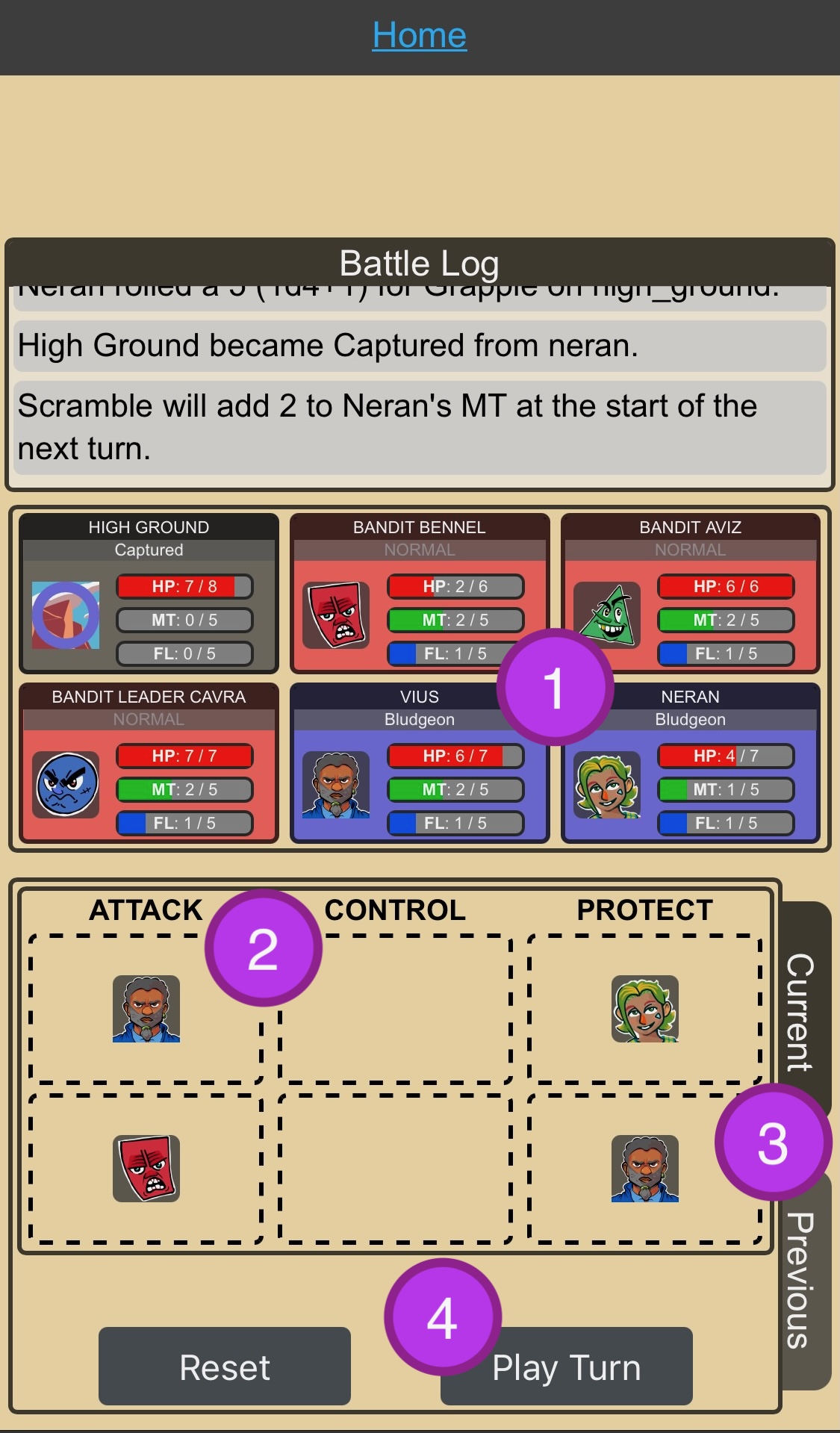
- Character Tray – Refer to this for a quick overview on the state of the battle or click one of the character boxes to bring up its details.
- Intent Zone – Drag a character from tray into one of the six boxes. The top row specifies who is taking the action in that intent, while the bottom row specifies the target of the intent.
- View Tabs – Switch between setting intents for the current turn or checking what happened on the previous turn.
- Play Turn – Once you've set up your intents and their targets, play the turn and see what happens!
One last concept to cover before playing, characters have three main resources. You can also see the status effects on the characters as well as their current controll state.

- Health or HP – The character dies when HP is reduced to zero. Read more about the injured condition in the full rules.
- Momentum or MT – Characters gain momentum at the end of each turn. At the beginning of each turn, their momentum is set to 0 if they changed intents from the previous turn. Some abilites either cost momentum or require a character to meet a momentum threshold.
- Flow or FL – Characters gain flow whenever they change intents from the previous turn. Unlike momentum, you don't lose unless its spent. Some abilites either cost flow or require a character to meet a flow threshold.
That's all you need to start playing. Your objective is to either kill or capture all opponents (the characters in red). Below is a video of a turn being played out, along with a brief description of what transpired. I'd suggest playing a battle before reading the full rules.
- Vius intends to control the High Ground, while Neran intends to attack Bandit Aviz.
- Once the turn played out, Vius power failed to exceed the High Ground's RST, so the control attemp failed.
- Neran's power matched Bandit Aviz's RST, so his attack did 1 damage.
- All three enemies attacked Neran with a total power of 21. Since Neran's resistance is 6, their attack did 3 damage (21/6 has a quotient of 3).
- Last, the attack triggered Bandit Leader Cavra's Bludgeon ability.
This section will provide greater detail on the games rules.
Active abilities use power to determine whether they're successful. Power is affected by the character's stats as well as a random element. Every participant in the inent adds their ability's power to the total power for the intent. In general, if the participant's total power is higher than the target's resistance (RST), all abilities in the intent will be considered successful. To cover how power is used, refer to the details below, but remember the game takes care of all of this for you.
- Attack – Divide the power by the target's total resistance (RST). The quotient (how many times it divides cleanly) is how much damage you do to your targets. The remainder is used for collateral damage, but that's covered in the Full Rules.
- Capture – As long as you have higher power than the target's total resistance (RST), the capture is successful. Soon to be implemented, if two teams try to capture the same characters in the same turn, it will trigger a contest.
-
Protect
– As long as you have higher power than the target's total resistance (RST), the
protect is sucessful and all participants of the protect intent will be swapped out
as the targets for any attack or control intent their target's
appeared (with one exception). Similar to attacking, the protectors get bonus RST
equal to the quotient of the participant's total power divided by the target's total RST.
The exception is when all the protectors are already the targets of the intent. In that case, the targets won't be swapped.
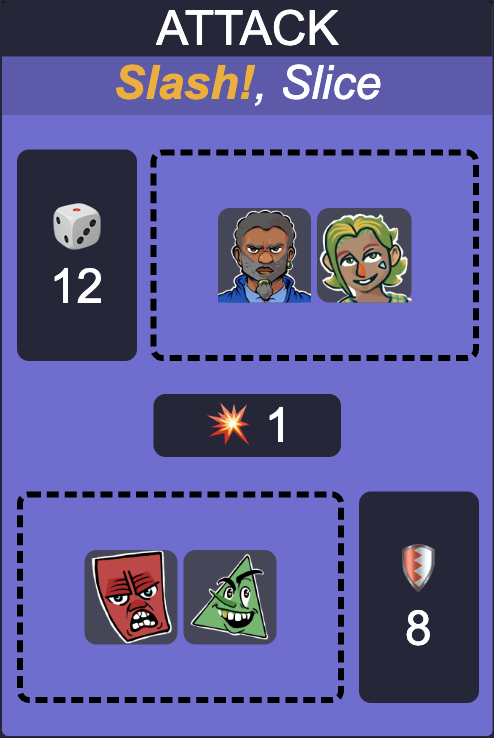
In the image below, Vius's Slash and Neran's Slice had a total power of 12. Bandit Bennel and Aviz have a total RST of 8. The quotient of 12 / 8 is 1, so they deal 1 damage to Bandit Bennel and Aviz.
There are three primary types of abilities: Active, Triggered, Static.
- Active – An ability which is used as part of an intent. These abilities use power to determine whether they are successful.
- Triggered – An ability which has a one-time effect when a certain condition is met. These will often cost momentum or flow to trigger.
- Static – An ability which provides a constant effect so long as its conditions are met. These will often have a momentum or flow threshold.
Characters have different abilities depending on the intent they choose. To put it another way, an ability set for a differnt intent than the one the character chose will have no effect, even if its conditions are met.
For each intent type, characters can set up to four abilities: a basic, a special, and two extras.
- Basic – An active ability with no cost.
- Special – An active ability with a cost.
- Extra (1 & 2) – A static or triggered ability.
Characters also have inate abilies which are available regardless of the intent they choose. A character can have up to four inate abilities, but most won't have more than two.
When a control intent is successfully performed on a character, their control state increases. There are three control states (outside of neutral): caught, constrained, captured.
- Caught – The character no longer receives bonus ability power, bonus move power, nor bonus damage.
- Constrained – In addition to the effects of being caught, the character cannot attack or control. They can only protect.
-
Captured
– Captured works differently depending on the type of the character.
- For tactical characters, they are now just controlled by the capturing team (often giving some advantage as a result). If you want to relinquish control of a tactical character, set it as both a participant and target of a Control intent. This doesn't require any roll to be successful, but it will happen in the turn order.
- For every other character type, they are removed from the fight until they are rescued. To rescue an ally, you only need to successfully perform a Control intent on them once; however, their RST will be greatly increased while they're captured.
At the end of each turn, a non-tactical character's control state resets to neutral if they're not already captured or they weren't successfully controlled that turn. Effectively, you have to successfully control a character three turns in a row to remove them from the fight.
You might see some abilities refer to bonus power or bonus damage:
- Bonus Power – Additional power that may be added to the intent's total power, to the character's individual abilities, or to the moves within those abilities.
- Bonus Damage – Additional damage as long as the attack is already successful.
Keep in mind that when a character is caught, they no longer receive bonuses.
When you attack, the quotient of your intent's power divided by the target's total RST is dealt as damage. The remainder is used to determine collateral damage. That remainder is treated like an attack against every tacical character individually.
Lets say your attack intent has a power of 17 against a total RST of 12. 17 / 12 has a quotient of 1 with a remainder of 5. Now lets say there is a tactical character Dummy with a RST of 2 and another Wall with a RST of 6. That remainder of 5 will be applied to each tactical character. For the dummy, 5 / 2 has a quotient of 2, so the Dummy will take 2 damage. For the wall, 5 / 6 has a quotient of 0, so it won't take damage.